It's no secret that newsletters are having a moment. Journalists are leaving major news outlets to go independent. Brands are acquiring email media companies at a rapid clip. And advertisers who once poured budget into social and display are quietly shifting dollars toward the inbox.
The reason isn't hard to find. Email advertising delivers an ROI of $36-$42 for every dollar spent, making it the top-performing channel in most marketers' mix. That kind of return doesn't happen by accident. It happens because newsletters reach real, opted-in audiences who want to hear from the publications they subscribe to.
Newsletter sponsorships sit at the center of that opportunity. But if you haven't run one before, the landscape can feel opaque: What do they cost? How do you find the right newsletter? What metrics matter now that Apple's Mail Privacy Protection has made open rates unreliable?
This guide covers all of it — from the basics to current benchmarks — so you can go in with a clear picture.
In this guide:
- •What a newsletter sponsorship is (and how it differs from a regular ad)
- •The top 3 sponsorship formats
- •How newsletter sponsorships compare to email marketing
- •Current pricing benchmarks and how to evaluate them
- •How to run a newsletter sponsorship from scratch
What is a newsletter sponsorship?
A newsletter sponsorship is a paid placement within an email newsletter. Unlike a standard display ad, it's natively integrated into the surrounding content. It’s designed to feel like part of the reading experience rather than an interruption to it.
Example of a newsletter sponsorship
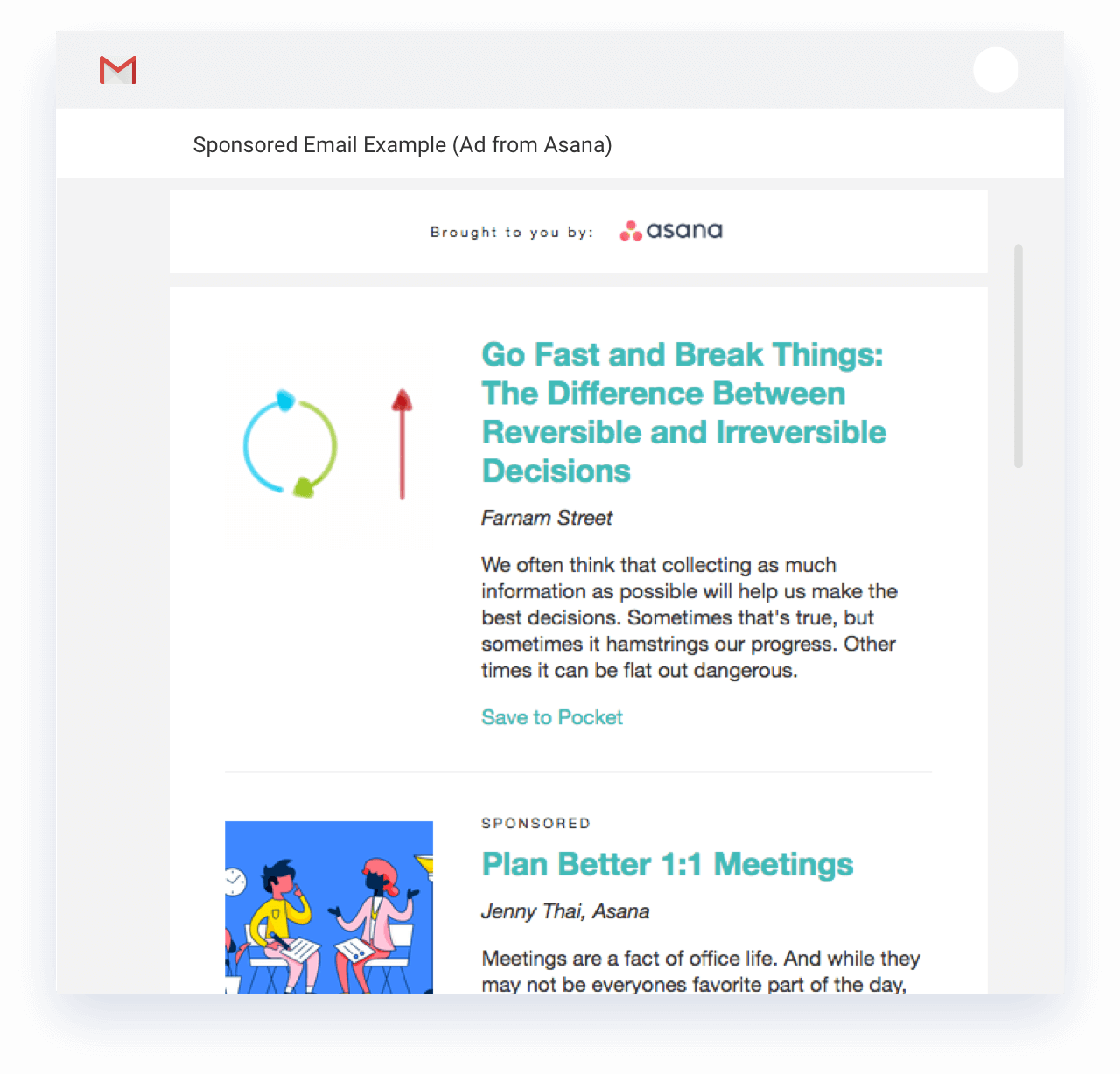
Think of how YouTube sponsorships work. A pre-roll ad plays before the video; a sponsorship appears inside it, delivered in the creator's own voice. Newsletter sponsorships work the same way: your brand shows up where readers are already paying attention, embedded in content they chose to receive.
That native quality is what separates newsletter sponsorships from most other ad formats. There's no algorithm to fight, no ad blocker to dodge, and no competition from the other 15 tabs a reader has open. It's just your message, in an inbox, in front of an audience that opted in.
Sponsored email vs. dedicated email vs CPC ads
Every newsletter sponsorship falls into one of 3 formats:
Format
What it is
Best for
A single placement within a regular newsletter issue
Testing new audiences, brand awareness at scale
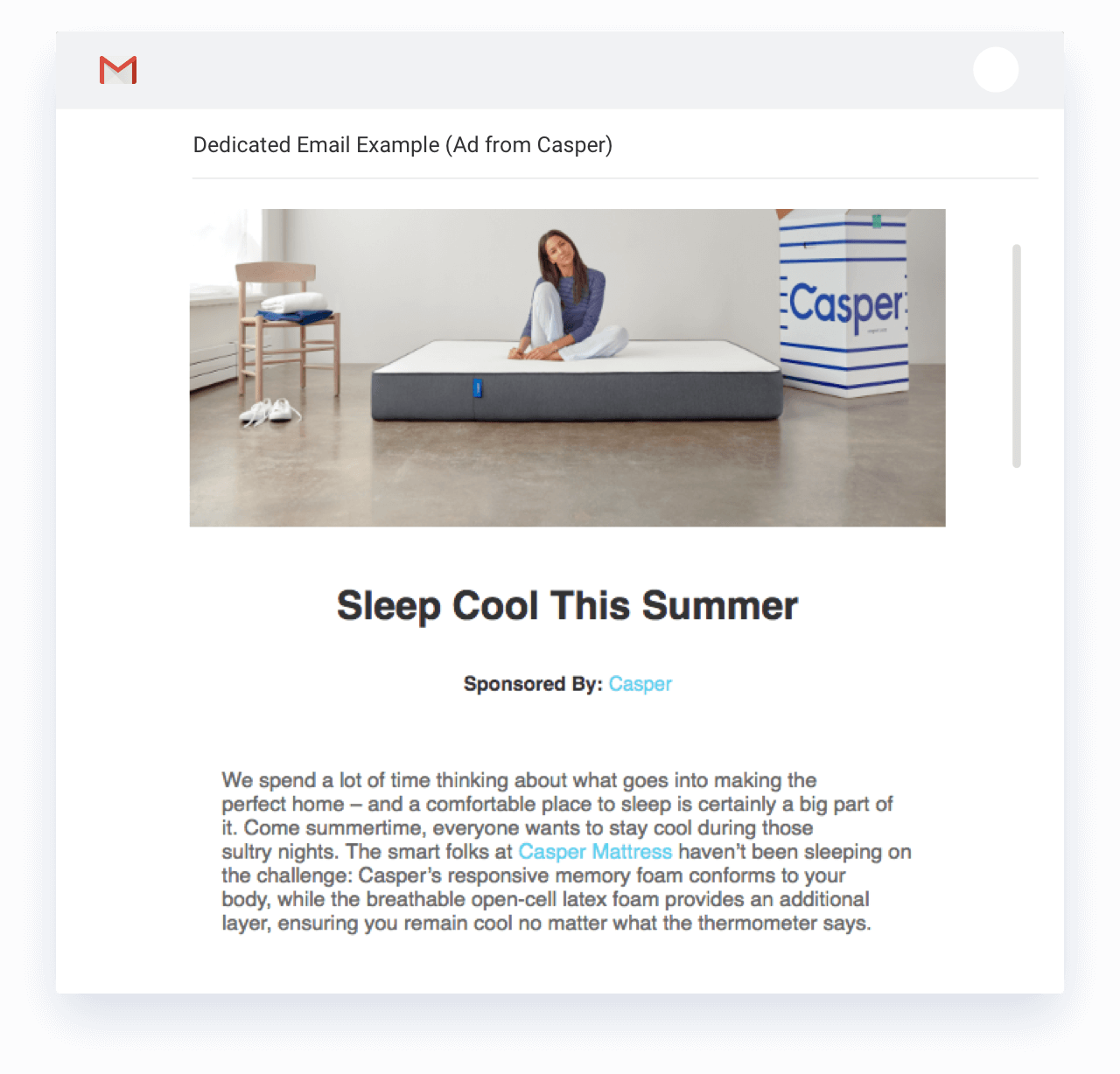
An entire send devoted to your brand
High-intent campaigns, product launches, list-building

A smaller pay-per click ad, dynamically inserted into multiple newsletters at once
Precise targeting, scaling offers across many publications
Sponsored emails appear alongside the publication's regular content. They can take the form of featured headers, native ads, display placements, or classifieds. Because they share the page with editorial content, they tend to be more affordable, which makes them a smart starting point if you're testing a new newsletter or niche.
Dedicated emails hand you the entire send. You control the design, the message, and the CTA. The publisher's sender name and logo typically still appear (to distinguish it from spam), but the content is yours. Dedicated emails cost more, but they also drive higher engagement. They're the format to reach for when you have a specific conversion goal in mind.
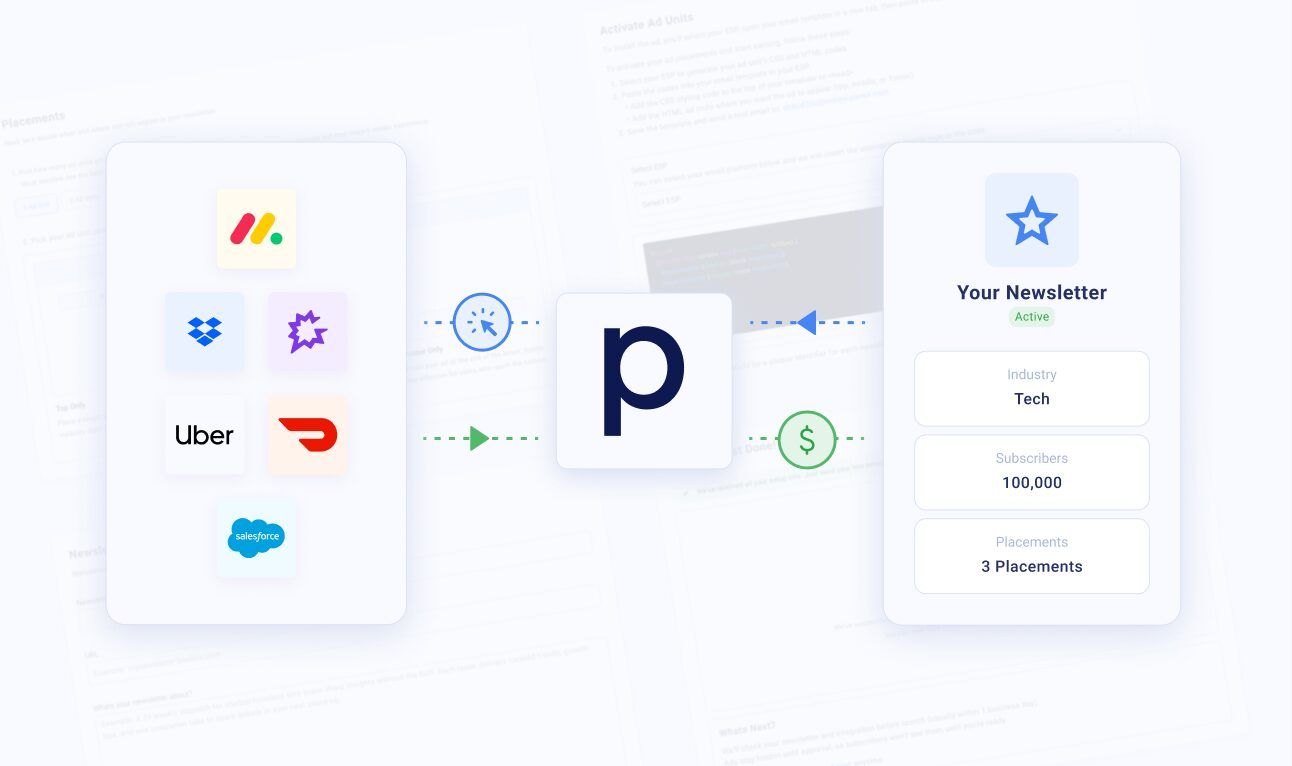
Native CPC ads work a bit differently from both formats above. Rather than negotiating a single placement with one publisher, you can serve one ad to interested subscribers across an array of newsletters simultaneously. You set your targeting parameters, and the ad finds its audience based on interests, with no manual coordination required. It's a performance-based model that's especially useful for testing creative or scaling a proven offer across multiple publications at once.
Read: Paved's Creative Specs
Newsletter sponsorship vs. email marketing
These two channels often get lumped together, but they serve different purposes. Understanding the distinction helps you use both more effectively.
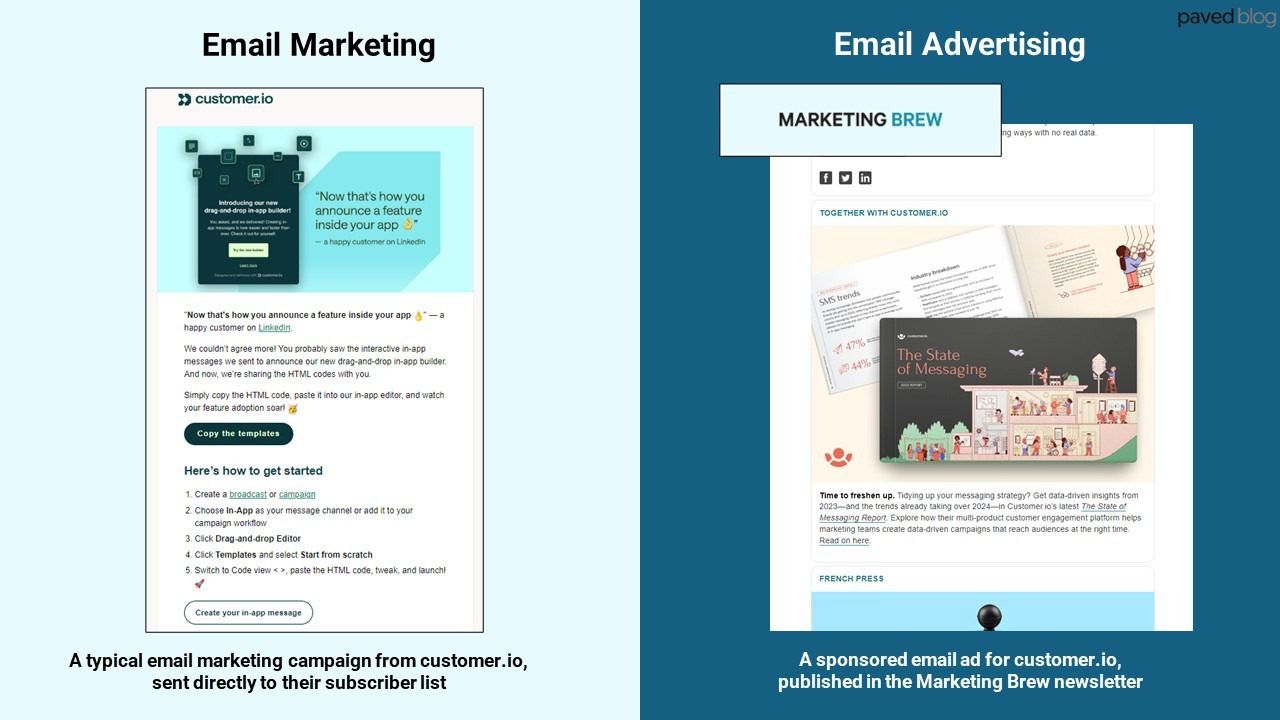
Email marketing is direct communication with your own subscriber list. You own the relationship. You control the send schedule, the content, and the data. It's one of the best tools for nurturing leads and retaining customers. But building a quality list takes time, and the reach is inherently limited to people who already know you.
Newsletter sponsorships let you borrow someone else's audience. You're not building a list; you're tapping into one that's already engaged and trusts the publication. A single sponsorship in a well-matched newsletter can put your brand in front of tens of thousands of new readers in one send.
The two strategies aren't competing; they're complementary. Email marketing deepens relationships with people who already know you. Sponsorships introduce you to people who don't. Most brands with a strong email program benefit from running both.
Read: Email Marketing vs. Newsletter Advertising: What's the Difference?
Why are newsletter sponsorships important?
A few things make them worth the investment beyond ROI:
- •Built-in targeting.
Newsletters are interest-based by nature. A fintech newsletter reaches fintech enthusiasts. A developer newsletter reaches developers. You don't need to layer on audience targeting because the editorial focus does it for you. - •No ad blockers.
Your placement lands in the inbox, not on a webpage where it can be filtered out. Delivery is guaranteed to subscribers. - •Credibility by association.
Sponsoring a newsletter that readers trust transfers some of that trust to your brand. That's a meaningful edge compared to a display ad on a random website — or a social platform where, according to Statista, 41 percent of US adults said that they did not trust information posted on social media platforms. - •Cookie-free targeting.
As third-party cookies disappear, newsletter sponsorships offer a durable alternative. It’s audience-first targeting that doesn't depend on tracking infrastructure. - •Professional audiences with high earning potential.
In the 2026 Newsletter Report, Pew Research Center shared that Americans with higher incomes and higher levels of formal education are more likely to get news from newsletters.
How much does a newsletter sponsorship cost?
Pricing is where most first-time sponsors get confused — and where the right framework makes a significant difference in how you evaluate campaigns.
CPM: the standard pricing model
Newsletter sponsorships are often priced on a CPM basis (cost per mille, or cost per 1,000 subscribers).
Current CPM benchmarks for the most rebooked newsletters on Paved:
| Newsletter type | Average CPM |
|---|---|
| General interest / broad audience | $6.53 |
| Highly targeted / premium niche | $23.01 |
These figures align with Paved’s Newsletter Performance Report, which notes that targeted newsletters can command more than the standard CPM rate. A B2B tech newsletter with 40,000 engaged subscribers will cost more per send than a general lifestyle newsletter with 200,000, and often produce better results.
CPM is simple to calculate and easy to compare across publishers. The only catch: it treats subscriber count as a proxy for value, which isn't always accurate.
Why CPC is the better benchmark
At Paved, we recommend evaluating newsletter sponsorships on CPC (cost per click) rather than CPM alone. Here's why: clicks are a direct signal of engagement. They tell you how many readers responded to your placement — not just how many people theoretically received it.
To estimate CPC before committing:
- Request average click data from the publisher (or pull it from their Paved profile)
- Divide the sponsorship cost by average clicks to get estimated CPC
- Layer in your landing page conversion rate to project CPA
Current CPC benchmarks for the most rebooked newsletters on Paved:
| Newsletter type | Average CPC |
|---|---|
| General interest / broad audience | $4.96 |
| Highly targeted / premium niche | $18.36 |
A note on open rates
Open rates used to be the first metric publishers would share. That's changed.
Apple's Mail Privacy Protection (MPP), rolled out in 2021 and now widely adopted, pre-loads email content in a way that inflates open rates artificially. A newsletter that reports 55% open rates may have a real human open rate closer to 30%.
The metrics that matter in 2026:
- •Click-through rate (CTR)
- •Sponsorship clicks
- •Estimated CPC (based on actual click data)
- •Conversion rate on your landing page
When evaluating a newsletter, ask for click data — not open data. Any publisher worth working with will have it.
Read: A Marketer’s Guide to Scaling Newsletter Ad Budget
Dynamic native ads: a close alternative
Before diving into how to run a direct sponsorship, it's worth knowing that direct deals aren't your only option.
Native email advertising works like any other CPC channel: you set your target audience, budget, and run dates, and your ad automatically appears across a network of newsletters that match your criteria.
The Paved Ad Network operates this way — you define the parameters, and placements run across relevant publications without manually coordinating with each publisher.
The tradeoff is customization. These placements are efficient and scalable, but they can't achieve the same native integration as a hand-crafted, individually negotiated sponsorship. If you're testing a new channel or trying to reach a broad audience quickly, an ad network is a strong starting point. If you want a deep, native integration with a specific publication, direct deals are the way to go.
Many advertisers run both: native for scale and discovery, direct sponsorships for their highest-performing newsletters.
How to run a newsletter sponsorship
Running a newsletter sponsorship well isn't complicated, but it does reward preparation. Here's the process from start to finish.
1. Define your goal
Every sponsorship should start with a specific, measurable objective. Vague goals produce vague results. Common goals include:
- •Lead generation: How many sign-ups or form fills do you need to break even?
- •Product sales: What's your target CPA, and does the estimated CPC support it?
- •Brand awareness: Which newsletters reach the audience segment you're trying to enter?
- •Traffic: What's a click worth to you, and does the CPA math work out?
Write down a target number before you book anything. It gives you a clear benchmark for evaluating results, and a basis for deciding whether to run again.
2. Build a strategy
Before reaching out to publishers, nail down the basics of your campaign:
- •Audience: Are you targeting a specific role, industry, or interest group? Or testing broadly?
- •Format: Sponsored placement or dedicated send?
- •Creative: What's your headline, visual, and CTA? Do you have two versions to test?
- •Landing page: Does it match the ad's message and CTA? Landing page alignment is one of the most underrated factors in sponsorship performance.
Starting with a rough A/B test framework — two versions of your creative or CTA — gives you something to optimize from, rather than starting from scratch after your first placement.
3. Find the right newsletter
This is the most important decision in the process. A great placement in the wrong newsletter will underperform every time.
What to look for:
- •Niche alignment: Does the editorial focus match your target audience?
- •Engagement quality: What's their average CTR? (Ask for it, or check their Paved Marketplace profile for transparent performance data)
- •Audience demographics: What makes the readers unique? Subscriber count matters less than who those subscribers are
- •Send frequency and recency: How often are they sending? A newsletter that sends consistently and recently is a healthier list than one that sends sporadically
- •Brand safety guardrails: Is the newsletter content compatible with what you’re advertising? For instance, an ad for a mental health app next to jarring news headlines could send the wrong message, so a positive newsletter could be a better fit.
- •Packages: Do they offer sponsorship bundles or packages? This can be a great way to test a few sends and find what clicks for their audience.
Don't rely on subscriber count alone. A 10,000-subscriber newsletter with a 5% CTR will drive more clicks than a 100,000-subscriber newsletter with a 0.5% CTR — and probably at a lower effective CPC.
Read: Here Are the Best Ways to Find Newsletters Right Now
4. Design your creative
Native sponsorships perform best when they feel like part of the newsletter, not an intrusion into it. That means:
- •Matching the publication's tone. If the newsletter is conversational and informal, your ad copy should be too.
- •Collaborating with the publisher. Many publishers will help you adapt your creative to fit their format. Take them up on it.
- •Leading with value, not promotion. The best-performing sponsorships offer the reader something useful — a tool, an insight, a discount — before asking for anything in return.
Read: How to Design a Sponsorship Placement to Maximize Revenue
5. Track your results
Before your campaign goes live, confirm the tracking setup with your publisher. At minimum, you'll want:
- •Click data from the publisher (total clicks on your placement)
- •UTM parameters on your destination URL so you can track traffic in your own analytics
- •A Paved tracking pixel if you want to measure post-click conversions directly
Once the campaign runs, calculate your actual CPC and compare it to your pre-campaign estimate. If it's within range and your landing page conversion rate holds up, you have a repeatable playbook. If it's off, diagnose whether the issue is the newsletter, the creative, or the landing page — then adjust accordingly.
Ready to launch?
Newsletter sponsorships are one of the most underutilized channels in most advertisers' mix — and the performance data makes a strong case for changing that. With newsletters commanding engaged audiences that no social algorithm can replicate, the case for getting started is straightforward.
The harder part is finding the right newsletter, negotiating the deal, and making sure your tracking is set up before launch. That's what Paved is built to handle.
Sign up as an advertiser to access the Paved Marketplace, browse publisher profiles with transparent performance data, and launch your first campaign — or scale the ones that are already working.
If you publish a newsletter and want to start earning through sponsorships, sign up as a publisher.