
When you’re running an email newsletter, following your intuition can get you pretty far. In fact, many publishers develop a sense of uniqueness and authenticity through building a personal brand.
However, as you scale your newsletter, testing your ideas can ensure that you deliver the best experience for your readers. That’s why many publishers use quantitative methods like A/B testing to make data-driven decisions. Let’s talk about how A/B testing works, plus how you can set it up for your newsletter.
What is A/B testing?
A/B testing, also known as split testing, is an optimization strategy that many companies will use to compare two versions of a single product. To run an A/B test, a researcher will randomly split an audience into two groups. Then, they’ll deliver variant A to one group and variant B to the other. Based on the performance of each version, they’ll figure out which worked better and use the results to inform future company decisions.
What does A/B testing look like for newsletter publishers?
In the context of email newsletters, publishers will run A/B tests by delivering slightly different versions of the same newsletter to two subgroups from their subscriber list in order to optimize a specific component. For example, one creator may use A/B testing to determine if subject line personalization yields a higher open rate.
For this, they would divide their audience into two groups. Then, they’ll send the exact same message to both, but the email subject lines would be slightly different.
Group A’s subject line: Ready for the weekend?
Group B’s subject line: Ready for the weekend, John?
Then, you’d compare the open rate for each group to determine whether personalizing the subject line improved your performance.
Some publishers may even use A/B testing to boost their metrics for a single issue. For example, they may only test on half of their readers by placing 25% in group A and 25% in group B. Once they’ve drawn a conclusive result, they’ll send out the winning version to the remainder of the email list.
How to improve your newsletter with A/B testing
A/B testing is an effective way to optimize any part of your newsletter. Publishers launch A/B tests on a wide range of components, including:
- •Subject line: How long should this be? Should you use emojis? Should you include your company name?
- •Send time: What time should your newsletter go out everyday? Does it vary by region or demographic?
- •Layout: How long should each paragraph be? What order should your sections appear in?
- •Personalization: Should you personalize your emails? How much? Where is personalization most effective?
- •Headline: How long should your headline be? What tone works best?
- •Image: Do readers prefer photos, graphics or GIFs? What types of images perform best? Where should you put them?
- •Promotional offer: Do your subscribers prefer to download an eBook or a case study? How should you phrase your offer?
- •Call-to-action (CTA): Should you include a button or a hyperlink? What phrasing should you use? How long should the text be?
- •From name: Should you send your messages from a specific person or a company account? Does it vary depending on the email campaign?
Pros of A/B testing
A/B testing is one of the most effective marketing tools for organizations across every industry. Testing campaigns can yield many benefits compared to other optimization methods.
Showcases real-life behavior
A/B testing is similar to running a randomized controlled trial, which many researchers cite as the most accurate and reliable study design. Unlike other research strategies like focus groups or user interviews, A/B testing gives you insight into what your customers are doing in a real-life scenario. This allows publishers to gain accurate results without worrying about inadvertently influencing their participants.
Delivers timely results
Many publishers will set a strict time limit on their A/B tests, often spanning only a few hours. At the end of this timebox, they’ll compare their results and draw a conclusion. This enables them to get quick, actionable insights from every test.
Poses minimal risks
A/B testing allows you to pilot a change to a small subset of your readers before sending it out to a wider audience. For that reason, it’s an effective strategy for testing ideas that you think your audience might react poorly to. Outside of newsletters, many tech companies employ A/B tests on a regular basis to gauge user interest for new features.
Limitations of A/B testing
While A/B testing is an impactful strategy for many publishers, it also has its fair share of drawbacks. For that reason, it’s up to you to determine whether A/B testing is the best solution for the situation.
Requires time and effort
While A/B testing is often worth the investment, it still requires significant resources to conduct. Therefore, although it may be tempting to run tests as often as possible, you’ll want to consider what you’ll get out of it beforehand.
If you’re unsure, ask yourself a few questions to determine whether an A/B test is necessary:
- •How impactful will this change be if implemented?
- •How confident are you that the change will have a positive effect?
- •How easy is it to run an A/B test for this change?
If it’s not clear whether the value of the test will outweigh the cost of running it, it may be better to skip it.
Creates a subpar experience for some readers
Many marketers criticize A/B tests for delivering low-quality materials to one test group. Imagine running an A/B test to find that group A yielded a 20% open rate while group B yielded an open rate of 5%. While the test was successful in identifying a clear winner, your overall open rate is lower than if you’d only sent out version A.
Of course, you won’t know which version will perform better until you conduct an A/B test. For that reason, the cost of testing is often justified based on the upside potential. However, it’s important to keep this expense in mind to avoid running excessive tests.
May return inconclusive results
A/B testing isn’t necessarily the best solution for every publication. For instance, a newsletter with a smaller readership may find it difficult to gather enough data to draw a definitive conclusion. Even publishers with a lot of subscribers may face the same issue if they don’t see enough participation. To solve this problem, many creators plug their test results into an A/B testing calculator to confirm that they’re statistically significant.
How to start A/B testing your newsletter
A/B testing can be a valuable tool for improving your newsletter using definitive data. However, many publishers don’t know where to begin. We’ve put together a step-by-step guide to running your first A/B test.
Craft a hypothesis
In order to run a successful A/B test, you’ll need to start with a specific question. What are you aiming to improve, and how are you planning to do it? For example, it’s not enough just to say that you want to optimize your call-to-action button text. Instead, start by identifying a change that you think might improve a specific metric related to that component.
In this situation, you might evaluate your current CTA button copy and suggest that it’s too lengthy. In turn, you’ll hypothesize that a shorter, catchier phrase will boost your click rate.
When creating a hypothesis, make sure to identify the two main elements:
- Variable: the component of your email that you want to test (ex: send time, preheader text, landing page)
- Metric: the results that you want to measure based on your change (ex: open rate, click-through rate, conversion rate)
Design and run your test
Once you’ve decided on a hypothesis, it’s time to start putting together your A/B test. Based on the variable you defined in the previous step, create two alternatives to send out.
Make sure that the change is specific enough to allow you to see definitive results. For instance, let’s say that your hypothesis is that using graphics instead of photos will boost your click rate. If version B is a complete redesign of version A, it can be hard to pinpoint what participants are responding to. Instead, focus on tweaking a specific aspect of your email design, such as swapping out only the visuals to see how it affects engagement.
When it comes to running your A/B test, you’ll need to take stock of the tools at your disposal. Many of the top ESPs, including Mailchimp, HubSpot and SendGrid, offer features to streamline your email A/B testing.
Each provider includes varying levels of automation. While some may only allow testing for a limited number of email templates, others include built-in support for specific variables. Many will also allow you to define parameters like recipient split, determining metric and period length.
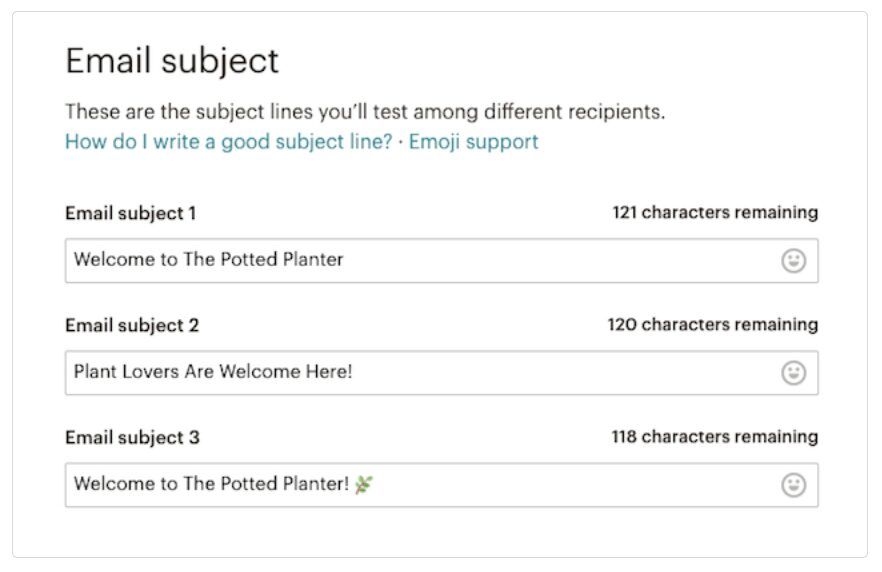
If your ESP doesn’t offer A/B testing, you can still run a test manually. First, you’ll have to randomly split your list into groups. If you’re testing a long-term improvement, you can split your list in half and add 50% to each group to maximize data.
Contrastingly, you can also opt to optimize your customer experience within a single marketing campaign. In this case, you’ll only test on a small fraction of your subscriber list. Some experts recommend following the 80-20 rule. In other words, sort 10% into group A and 10% into group B, then send the winning email to the remaining 80%. Again, make sure that your sample size is large enough to achieve statistical significance.
After you’ve decided on the percentage of subscribers in each group, you’ll want to determine a period of time during which to run your test. If you’re including your entire readership in your initial test, your time limit will be less crucial.
However, if you’re testing two different emails to figure out which to send to a majority of your list, you’ll want to cap the time around a couple of hours. That way, you can send the remainder of your subscribers a higher-performing version of the email before it’s too late.
Monitor your results
Once you’ve kicked off your A/B split testing, you’ll want to stay updated on your campaign’s status. Even if you’re running an automated test, keep an eye on how each version of your email is performing.
Make sure to monitor results that you aren’t testing for, like sends or unsubscribes. Running a test aimed at improving one metrics may end up affecting another even more.
Find out more ways to improve your newsletter
A/B testing can play a valuable role in improving newsletters and email marketing campaigns. However, it’s far from the only way to grow your publication. Check out our blog to learn more about how to level up your newsletter, from gaining subscribers to boosting your deliverability:
- •How To Get 10,000 Email Subscribers in 2022
- •How To Launch an Email Referral Program in 5 Steps
- •What Is BIMI, and How Can You Set It Up for Your Newsletter?
Sign up with Paved to connect with top advertisers and streamline your revenue.