Have you ever scrolled through Netflix for way too long, trying to find something to watch? Pix Media is here to help.
On average, people spend 15 minutes looking for their next piece of content, TV show, book, or podcast. So Pix’s aim is to solve that crisis of content discovery with vetted recommendations via newsletters.
Pix’s newsletter suite has attracted a whopping 3 million active subscribers. Often with open rates at 70% or above.
Today, we’re talking with Josh Epstein, Founder and CEO of Pix, to learn more about how newsletters shape his business and grow revenue.
The majority of our revenue is email newsletter–based.
-Josh Epstein, CEO of Pix

Hi Josh! So, tell us about Pix.
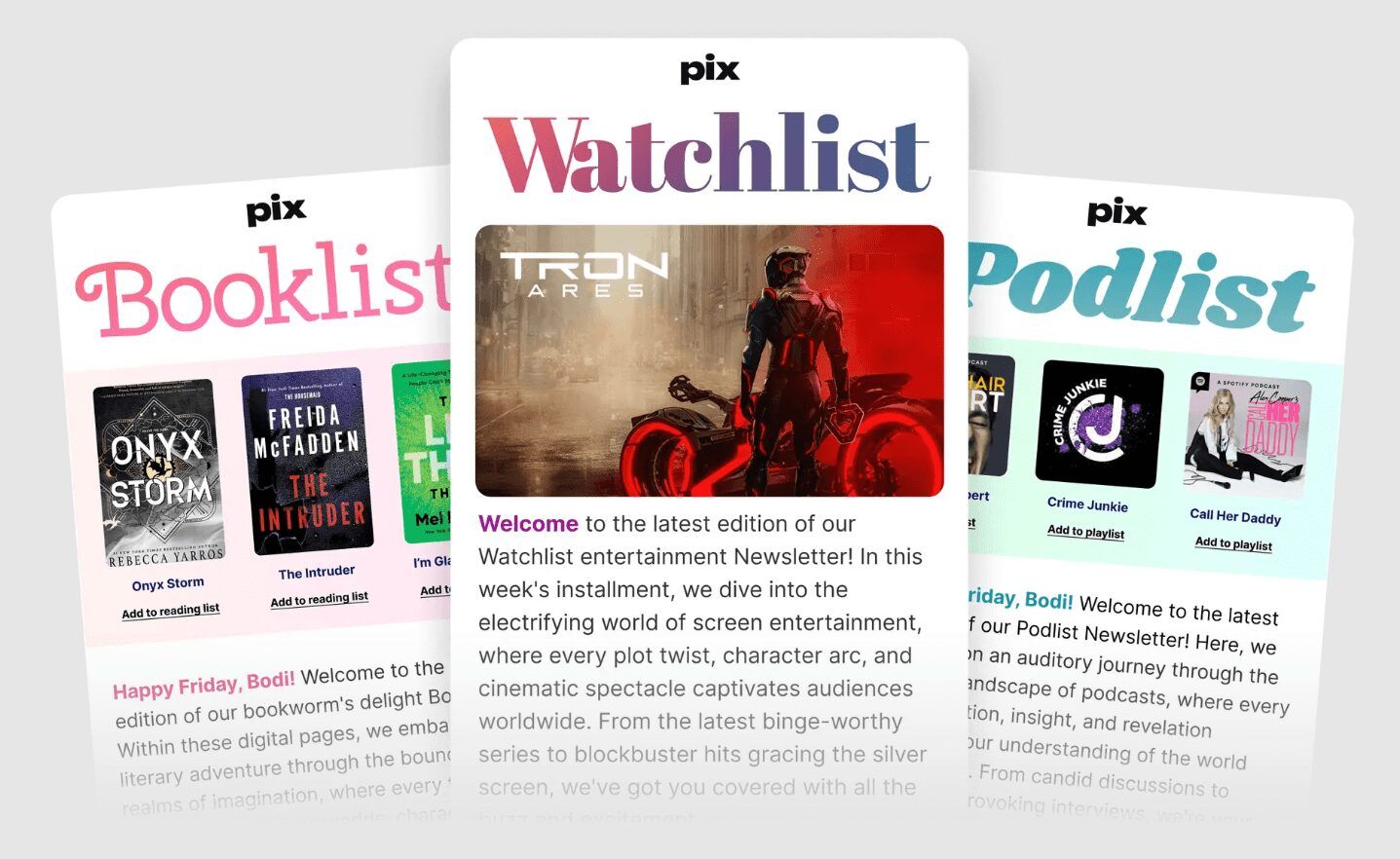
Pix is the largest entertainment email newsletter portfolio. Every day, we send personalized recommendations for books, movies, podcasts, and TV shows to nearly 3 million active subscribers.
Earlier this year, I acquired the company with a small group of media and tech investors I’ve worked with throughout my career. Since then, we’ve been focused on audience growth, engagement, monetization, and AI-led personalization, with a big emphasis on doubling down on email.
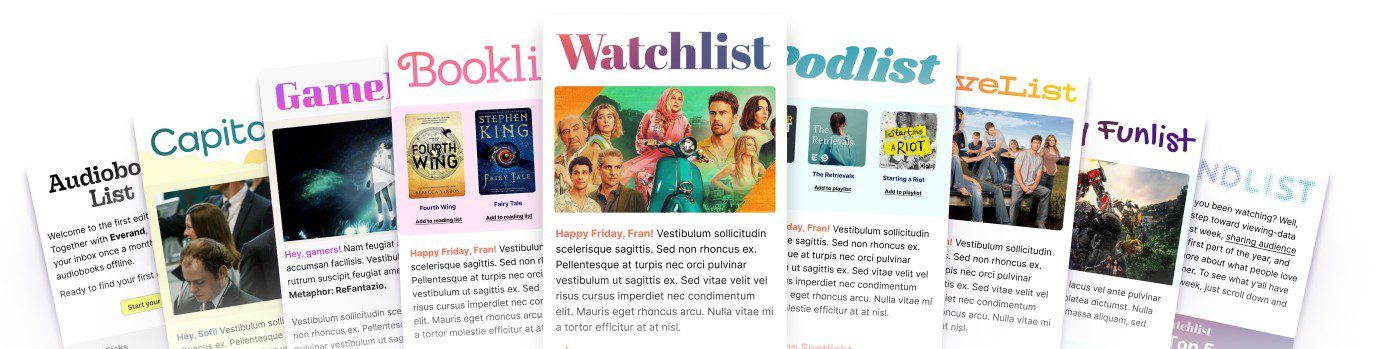
We publish four flagship newsletters: Watch List, Book List, Pod List, and Trend List. plus a number of niche imprints built around specific genres, audience segments, and partnerships.
We actually started as a mobile app about seven years ago. It worked as an entertainment concierge, using a mix of algorithms, social signals, and editorial picks. But it wasn’t part of people’s daily routine. That’s why we pivoted to newsletters.
Our goal is to be the trusted friend in your inbox every day. Someone with great taste and recommendations that feel personal. If you’re looking for a new show, book, or podcast, you know exactly where to turn.
When did you decide to shift more of the business toward newsletters, and what triggered that change?
About two and a half years ago, we started to pivot the company to lead with email newsletters.
The lightbulb moment was realizing that instead of pulling people into an app for recommendations, we could meet them where they already were: in their inboxes. We had an audience of about 8 million registered users from the app, and they were already opening our emails at strong rates.
So we flipped the model and started pushing content directly to them via email. Entertainment works really well in the inbox. People are always looking for their next show, book, or podcast. Email just fits naturally into that behavior.
We’ve been very bullish on newsletters ever since.
From a business perspective, how do newsletters impact costs and revenue? Do they offer meaningful advantages compared to building and maintaining a mobile app?
Email newsletters bring a few big things to the table for us. First, they give us real audience and scale. We’re just under 3 million active users today, defined as people who’ve opened an email in the past 60 days. That kind of scale matters if you want to be relevant to millions of people.
Email also lets us fully use our data. We’ve collected a lot of information from when users originally registered through our app, which allows us to personalize recommendations in a way that’s pretty unique for newsletters. If someone tells us they like true crime, we send true crime podcast picks. If they’re into family content, we recommend kids’ movies. We have about 600 million data points, and email is how we actually activate that data.
Finally, email is a great format for advertising. It supports deeply customized partner integrations that feel native to the content, and it enables hashed email attribution so we can track conversions and prove performance for partners.
With scale, personalization, and attribution, email has become a very powerful channel for us.
Since personalization is so important for Pix, how do you curate your newsletters?
We run everything off a shared editorial calendar that’s managed jointly by our editorial team and our email CRM team. One side focuses on creating the content, and the other looks at audience signals and performance—making sure the emails land in the primary inbox, get opened, and don’t drive unsubscribes.
That collaboration between editorial and CRM is really the engine of our business and our product. It’s where personalization actually happens.
We’ve built strong editorial systems, a clear voice, and some pretty innovative processes around product and email design. Together, those teams allow us to do things in a way that feels genuinely different.
When new subscribers join, do you use their data to personalize content right away, or do you guide them into more niche newsletters?
We do both. Our broad interest titles like Book List and Watch List have been really successful for new subscribers.
Since the acquisition, we’ve also launched several new, more niche imprints that personalize at a higher level, around interests and genres. Those include The Portal for sci-fi, The Scroll for digital-native content, The Huddle for sports, and Main Character for young adults.
These let us focus on specific genres and audience segments that are highly relevant, especially for advertisers. And they’ve performed extremely well. Some of those newer editions are seeing open rates at or above 70%.
Do you have any advice for newsletter publishers or people who grow as big as Pix someday?
If you’re starting from scratch today, my biggest advice is to be crystal clear on your value proposition.
Ask yourself: why do you deserve space in someone’s inbox? What are you delivering—daily or weekly—that’s genuinely unique and worth signing up for?
That’s something we focus on constantly when we launch new titles, bring in new subscribers, or try to re-engage people.
Pix started as an app-first business, but that’s clearly evolved. How central are newsletters to the business today? Would you describe Pix as a newsletter-led company now, or still primarily an app company?
We’re definitely newsletter-led today, but within a broader product ecosystem. Email is the main entry point and the primary way people engage with us.
That said, the app still plays an important role. If someone discovers a podcast or show in a newsletter, they can save it to a watch list or explore it further in the app. The two products really support each other.
The app is especially valuable for our most engaged users, the people who want deeper functionality, more advanced personalization, and richer features. But email is the center of gravity for us. It’s where the relationship starts, and the app serves our power users once they’re more deeply invested.
Beyond your own newsletters, do you use other channels or tactics to drive traffic back to the Pix app?
We do, but selectively. We run a small amount of paid, inorganic media, which we’ve recently turned back on in a measured way. Mainly to support growth around some of our newer publications.
We’ve also put a lot of effort into re-engaging lapsed users, and that’s become a real strength for us. We’ve developed strong practices around bringing those audiences back into the ecosystem.
Finally, we’re exploring partnerships with other companies that have their own email portfolios. The idea is to extend our daily entertainment recommendations across books, TV, and podcasts to new audiences through those partnerships, and drive additional scale and engagement that way.
How much of your traffic comes from organic vs paid channels?
Most of our engagement is organic.
We’re increasingly optimistic about partnerships as a growth lever. There are some interesting opportunities there that could meaningfully expand the audience we reach.
We’ve also seen strong results from re-engaging lapsed users. People who may have signed up for the app a couple of years ago but hadn’t been opening our emails are starting to re-engage, and that’s become a more meaningful portion of our audience recently.
How have newsletters impacted revenue for Pix?
The majority of our revenue is email newsletter–based.
Since the acquisition earlier this year, we’ve been very intentional about treating each newsletter as its own product and making those experiences as robust and engaging as possible. We’ve experimented with different formats—some are more text-driven with a stronger voice, others are more list- or link-based—depending on what works best for that audience.
That evolution has really made newsletters the core product for us, and the primary monetization engine. There’s still a small amount of revenue coming from the app, mostly from partners who want access to our most loyal, power users, but it’s minimal by comparison.
Overall, revenue has grown steadily. We doubled revenue in each of the past two years, and we grew another 30% this year. Email newsletters have been the main driver behind that growth.
Would it be fair to say that your monetization team is now focused primarily on newsletters—with dedicated sales, product work, and a marketer-first mindset built around the newsletter ecosystem?
Yeah, exactly. We’re a pretty small, scrappy team—about 20 people—so a lot of our focus naturally centers on email newsletters. That’s where we put most of our energy today, across sales, product, and monetization.
Even though email isn’t the trendiest channel compared to social or video, this shows that you can still build a strong, sustainable business on top of it. And that’s encouraging for the entire newsletter ecosystem. Would you agree?
Absolutely. I’ve been bullish on email newsletters for a long time. Early in my career, I looked at acquiring email-based properties like DailyCandy and Thrillist—businesses built around an email audience, strong content, and integrated advertising.
I still see email as a real asset. Especially now, in an era of generative AI, when people may not go much further than a ChatGPT or Gemini starting point, having a direct line to your audience in their inbox is a strong competitive moat.
There’s still a lot of room for innovation in email, and I think the opportunity is far from tapped out.
Thanks for chatting with us, Josh!
To learn more about Pix, visit pix-media.com. To book a sponsorship of a Pix newsletter, check them out on Paved.