You've built a newsletter. Tens of thousands of people open your emails, click your links, and trust what you recommend.
Now an advertiser wants in and suddenly you have to answer the question nobody prepared you for: what do you charge for newsletter sponsorships?
Most publishers either guess, Google a number from a years-old blog post, or ask a fellow creator and get a wildly different answer.
The good news: you don't have to guess. We pulled benchmark data from newsletter sponsorships on the Paved platform. Check out the average pricing rates by category so you can see where your newsletter stands before you name a number.
This guide covers:
- •Sponsorship price benchmarks by newsletter category, sourced from Paved data
- •The four factors that move your rate up or down
- •How to calculate a starting price at any list size
- •When to graduate from a single flat rate to a tiered pricing model
Get the benchmarks: average newsletter sponsorship rates by category
We pulled updated sponsorship benchmarks straight from live Paved marketplace data, and one pattern holds no matter the category: a smaller, well-defined audience often out-earns a massive one.
Newsletters serving HR, career, and B2B audiences consistently command the highest revenue per subscriber, while some of the biggest lists in the marketplace rank near the bottom.
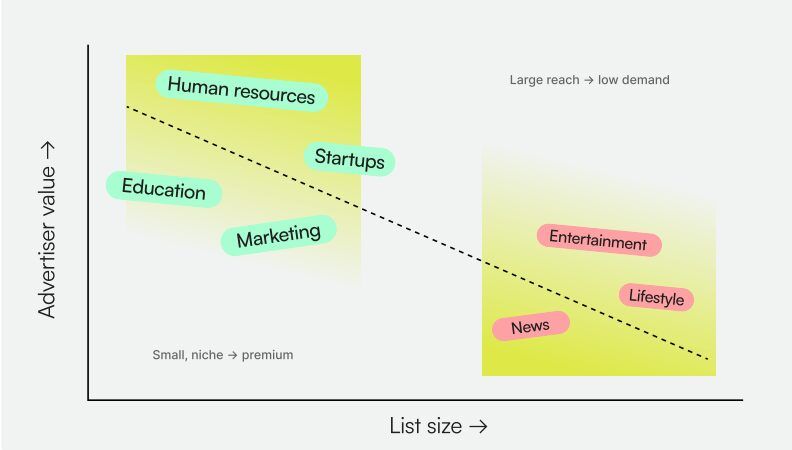
Your rate depends on your audience, your engagement, and how well your newsletter matches active advertiser demand in your category, not just your subscriber count.
What newsletters are actually charging right now
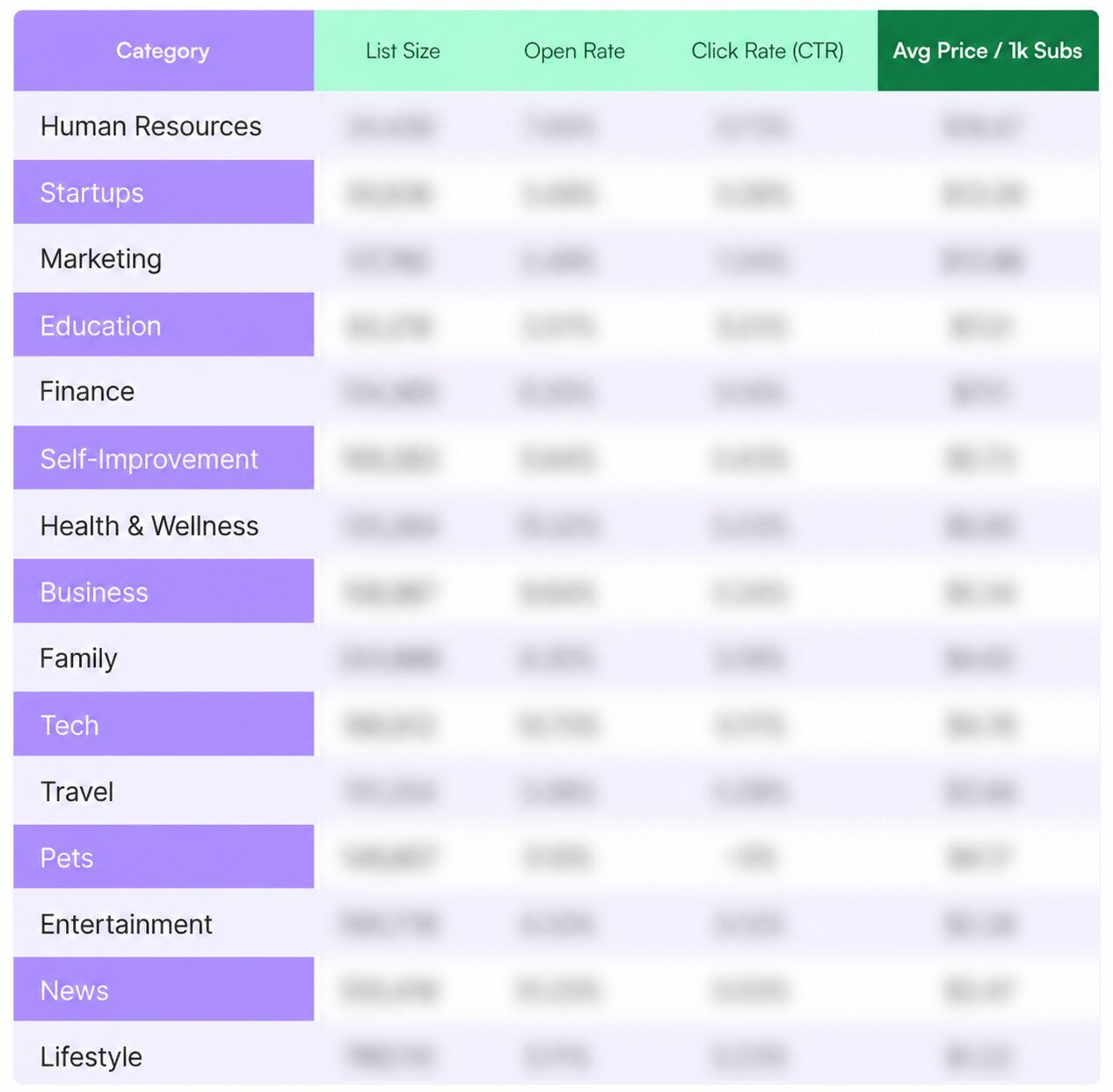
Download the full 2026 benchmark report for the complete category-by-category breakdown: list size, open rate, click rate, and average revenue per 1,000 subscribers, plus five moves you can make if your category isn't commanding premium rates yet.
How to set data-driven newsletter sponsorship prices
The benchmarks above reflect averages across newsletters of all sizes in each category. Your starting point depends on where you are relative to that average.
If you're just starting out:
Start with a flat fee and use this rule as your anchor: charge between 2.5-5% of your subscriber count. Err on the higher end of the range if most of your audience has high net worth, like CEOs, tech or finance professionals, or executives.
- •3,000 subscribers → ~$75-$150 per placement
- •5,000 subscribers → ~$125-$250 per placement
- •10,000 subscribers → ~$250-$500 per placement
It's a simple formula, easy to explain to advertisers, and gives you a defensible starting point while you build your performance track record.
If you're growing your sponsorship business:
You can use the same rule as above, or try a different strategy like CPM.
The formula:
(Subscribers ÷ 1,000) × your target CPM = your rate
Use the category benchmark as your CPM reference point. If your engagement rate is above average for your category and you have a high-demand audience, price toward the higher end. If it's below average, start in the middle and work up as performance data accumulates.
Practical example: A marketing newsletter with 20,000 subscribers and a 60% open rate (above the 40% category average) could justify $35–$40 CPM, putting the primary placement around $700–$800.
If you're optimizing your existing prices:
The key question at this stage isn't "what should I charge? It's "am I leaving money on the table on secondary placements and high-demand dates?" More on that below.
One thing every publisher should do: browse the Paved Marketplace to see what newsletters in your category are actively charging. Market data beats any formula.
When to add tiered pricing
A single flat rate works fine when you're starting out. Once you have consistent demand and multiple placement options, a tiered structure does two things: it maximizes revenue per send, and it gives advertisers flexibility without you discounting your best inventory.
The standard three-tier structure:
| Tier | Placement | Pricing Logic |
|---|---|---|
| Primary | Top of newsletter | Your full rate — highest visibility, highest CTR |
| Secondary | Mid-content | ~50–65% of your primary rate |
| Classifieds | Footer / link ads | ~25–35% of your primary rate |
Dedicated emails sit outside this structure. Price them separately at 2–5x your primary sponsored email rate, reflecting the exclusivity of a full send.
When you're ready to tier
You're ready when:
- •Your primary slot sells out consistently and you're turning advertisers away
- •You have more than one ad placement per issue
- •Advertisers are asking about options beyond your single rate
If you're still working to fill your first slot, don't overcomplicate it. Get that booked consistently, collect performance data, then build the structure.
Smart Pricing and Custom Pricing on Paved
If you're on Paved, two tools take a lot of the guesswork out of this. Smart Pricing lets you set a minimum and maximum rate and automatically adjusts based on demand. Newsletters using it are 7x more likely to get booked.
Custom Pricing lets you set premium rates for high-demand dates like Black Friday or Cyber Monday, so you're not leaving money on the table when advertiser budgets peak.
For the full setup walkthrough, our knowledge base guide covers both features in detail.
When to raise your newsletter ad rates
Setting your first rate isn't the end of the process. The clearest signs you're underpriced:
- •Multiple sponsors book immediately with no negotiation.
No pushback on price means room to go higher. - •You're sold out weeks in advance.
Demand exceeding supply is the definition of underpricing. - •Sponsors keep rebooking.
Repeat advertisers are proof of ROI, and that's leverage. - •Your CPC is above your category average.
Strong click-through data is the most credible justification for a rate increase.
Revisit your rates every six months or so. If demand is strong and performance is solid, increase by 10–20%. You don't need to make a big announcement; just update your rates and let the market respond.
Your audience is an asset you've built over time. Don't let a lack of comparable data talk you into pricing below what that trust is worth.
Start with a defensible number, prove your performance, and raise from there.
Ready to put your rates to work? Read our knowledge base guide to set up your pricing on Paved, including Smart Pricing, Custom Pricing, and your Sponsorship Availability Calendar.