It’s time to talk to people, not ‘subscribers.'
The passion economy is bubbling up and boiling over. With media distrust at an all-time high, people are trusting influencers to curate information into newsletters. Social engagement is fragmented over thousands of micro-communities.
And email advertising is finally opening up to advertisers.
A while back, we gave three publishers (newsletter owners) $100 each to see how much it cost to get new subscribers on Facebook. The results were mediocre.
This time, we tested the power of newsletters.
Setting up the email-based Ad Network
The conversion goal was to get more subscribers for each publisher at the lowest cost possible.
Paved’s Ad Network is a form of advertising similar to social media. You can target people based on their demographics, interests, job titles, and professional attributes. Except instead of a feed, it appears in someone’s favorite email newsletter.
We partnered with 3 publishers in the tech space to advertise their newsletters on the Ad Network:
- •Web Tools Weekly (11,750 subscribers)
- •HackerNoon Noonification (70,000 subscribers)
- •Hacker News Digest (7,911 subscribers)
It’s pretty simple to set up ads and get them live. Here are the parameters we used for each publisher.
Targeting & Budget
To keep it simple, the location for all campaigns was set to North America. The rest of the targeting criteria was done via contextual targeting -- aka content/topics that someone has engaged with over the last 30 days.
- •Web Tools Weekly
Contextual Interests: React, CSS, JavaScript, or Reactjs - •Hacker News Digest
Contextual Interests: Hacker News - •HackerNoon Noonification
Contextual Interests: news.ycombinator.com/*, Hacker Newsletter, Hacker News
*You can target by sites visited or clicked
Daily Budget: $20
The higher your daily budget, the faster you get results
Bid Type: CPC
The goal was to get signups, so cost per click was most effective. For brand awareness campaigns, choose CPM (cost per thousand impressions).
Bid Amount: $0.50
A newsletter subscriber offers a very low lifetime value to a mid-sized publisher (around $7 spread out over 2 years), so we lowered the bid significantly. This means it took much longer to get results as plenty of other advertisers out-bid us for the audience. For higher value sales and niche audiences (like CEOs and managers), you want to increase the bid to minimum $3.
Frequency Cap: 1 impression per subscriber
Newsletters need subscribers to open emails for the next 6 months to a year to be profitable. If a subscriber isn’t interested in the ad the first time around, they weren’t passionate enough for our publishers. This is different for high-value sales, SaaS software, and DTC products. In most cases, we recommend 7-14 impressions every two weeks.
Reporting
Paved automatically reports impressions and clicks (note: tons of bots can show up as ‘fake’ clicks. We filter those out. You will also want to track signups/acquisitions (also know as conversions or your CPA). Use a UTM link or a pixel.
If you don’t track your ad performance, you gamble away your budget.
It’s like giving a lump sum to a financial advisor, never looking at it again, and saying “I’m sure I’ll be able to retire in 30 years”. Maybe... or maybe that advisor lost it all on a risky Bitcoin bet. Best to check.
A/B Testing The Copy and Creative
Have you heard of an A/B test? It’s when you take two versions of something and test them against each other to learn which version resonates best with a certain audience.
When testing, it’s a good idea to start with wildly different ads and narrow down from there. Pick the winner and see if tweaking the headline boosts clicks or conversions.
For example, if you are selling meeting management software to managers and know that the concept of time-wasting resonates, you could test which message gets more traction:
Stop Wasting Time in Meetings vs. Make Your Meetings More Efficient.
A/B test things like:
- •Main Message/Value Proposition
- •Pain point vs Solution
- •Long Term Benefit vs Short Term Benefit
- •Long Term Pain vs Short Term Pain
- •Headlines
- •Button text
- •Images of people vs Graphic Elements
- •Body Description
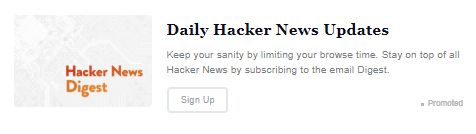
A quick overview of the ads. Can you guess which one will perform the best?
Each campaign had two ads. Can you guess which ad got the highest click-through rate for each publisher?
Hacker News Digest

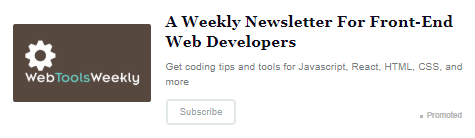
Web Tools Weekly

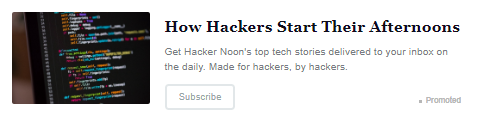
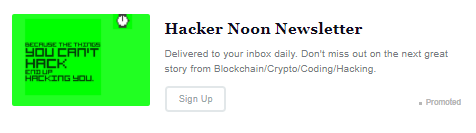
Hackernoon Noonification
Let’s take a look at the winners
The highlighted ad got the highest CTR (click-through rate) and the most clicks. The click-through rate is important because it shows the ratio of which ad was more effective no matter how much money was spent.
Hacker News Digest: Got Hacker News FOMO?

Web Tools Weekly: Useful Tools for Web Devs

HackerNews Noonification: How Hackers Start Their Afternoons

How to use these results to create and improve your own ads
This is a tiny experiment. But from it we can start to make some hypotheses and notice a few trends.
- Photos/realistic images do better than plain graphics
Every single graphic version lost. Every single ‘bright’ image also lost. This means darker, higher contrast photos did better. Possibly because the Ad Network images appear quite small on a desktop email. The darker and higher contrast it is, the better it catches your attention. - Emotional headlines perform better than fact-based ones
FOMO, useful tools, hackers starting afternoons. These are all grounded in a bit of emotion. It’s been proven many times over that us humans buy things with emotion more than logic, so this hypothesis is probably correct. - Headlines speaking to YOU performed better than those appealing to a general audience
What’s the difference between “Front End Web Developers” and “Web Devs”? Well, if your job title says “front end web developer”, you might refer to yourself casually as a web dev. It’s the group you identify with. You end up thinking “ah yes, I’m this type of person, this will be related to me”. - The button text and descriptions need more testing
We didn’t see a clear difference there, so it’s no use guessing. When testing, you should always note what needs more experimentation so you can keep improving.
What is the ad score?
The higher the ratio of people who see and click an ad, the higher an ad score. Ad score is a quick way for you to tell if your ad is performing well or not. And the higher it goes, the more the ad will be prioritized in the network.
Using the Ad Network to create targeted email ads
Email advertising is powerful. And it can be a valid alternative to expensive targeted ads on social media. The takeaway from this experiment is to continue experimenting with ad networks as a valid list growth tool.
Unlike well-documented platforms, this is a relatively untapped market. It’s new and fresh. People who subscribe to newsletters actually read. They’re paying attention. It’s up to you to capture and convert that attention into subscribers and sales.